Note
Go to the end to download the full example code.
Particle and amplitude
Amplitude = DecayGroup + Variable
We will use following parameters for a toy model
11 from tf_pwa.amp import DecayChain, DecayGroup, get_decay, get_particle
12
13 resonances = {
14     "R0": {"J": 0, "P": 1, "mass": 1.0, "width": 0.07},
15     "R1": {"J": 0, "P": 1, "mass": 1.0, "width": 0.07},
16     "R2": {"J": 1, "P": -1, "mass": 1.225, "width": 0.08},
17 }
18 m_A, m_B, m_C, m_D = 1.8, 0.18, 0.18, 0.18
19 a, b, c, d = [
20     get_particle(i, J=0, P=-1, mass=m)
21     for i, m in zip("ABCD", [m_A, m_B, m_C, m_D])
22 ]
23 r1, r2, r3 = [get_particle(i, **resonances[i]) for i in resonances.keys()]
24
25
26 decay_group = DecayGroup(
27     [
28         DecayChain([get_decay(a, [r1, c]), get_decay(r1, [b, d])]),
29         DecayChain([get_decay(a, [r2, b]), get_decay(r2, [c, d])]),
30         DecayChain([get_decay(a, [r3, b]), get_decay(r3, [c, d])]),
31     ]
32 )
The above parts can be represented as config.yml used by ConfigLoader.
We can get AmplitudeModel form decay_group and a optional Variables Managerager. It has parameters, so we can get and set parameters for the amplitude model
39 from tf_pwa.amp import AmplitudeModel
40 from tf_pwa.variable import VarsManager
41
42 vm = VarsManager()
43 amp = AmplitudeModel(decay_group, vm=vm)
44
45 print(amp.get_params())
46 amp.set_params(
47     {
48         "A->R0.CR0->B.D_total_0r": 1.0,
49         "A->R1.BR1->C.D_total_0r": 1.0,
50         "A->R2.BR2->C.D_total_0r": 7.0,
51     }
52 )
{'R0_mass': np.float64(1.0), 'R0_width': np.float64(0.07), 'R1_mass': np.float64(1.0), 'R1_width': np.float64(0.07), 'R2_mass': np.float64(1.225), 'R2_width': np.float64(0.08), 'A->R0.CR0->B.D_total_0r': np.float64(1.7626665686040006), 'A->R0.CR0->B.D_total_0i': np.float64(-2.8313475085729514), 'A->R0.C_g_ls_0r': np.float64(1.0), 'A->R0.C_g_ls_0i': np.float64(0.0), 'R0->B.D_g_ls_0r': np.float64(1.0), 'R0->B.D_g_ls_0i': np.float64(0.0), 'A->R1.BR1->C.D_total_0r': np.float64(1.6418534316418971), 'A->R1.BR1->C.D_total_0i': np.float64(-1.7958717270101727), 'A->R1.B_g_ls_0r': np.float64(1.0), 'A->R1.B_g_ls_0i': np.float64(0.0), 'R1->C.D_g_ls_0r': np.float64(1.0), 'R1->C.D_g_ls_0i': np.float64(0.0), 'A->R2.BR2->C.D_total_0r': np.float64(0.14836155427862074), 'A->R2.BR2->C.D_total_0i': np.float64(-2.369310694691472), 'A->R2.B_g_ls_0r': np.float64(1.0), 'A->R2.B_g_ls_0i': np.float64(0.0), 'R2->C.D_g_ls_0r': np.float64(1.0), 'R2->C.D_g_ls_0i': np.float64(0.0)}
For the calculation, we generate some phase space data.
and the calculate helicity angle from the data
65 from tf_pwa.cal_angle import cal_angle_from_momentum
66
67 data = cal_angle_from_momentum({b: p1, c: p2, d: p3}, decay_group)
we can index mass from data as
72 from tf_pwa.data import data_index
73
74 m_bd = data_index(data, ("particle", "(B, D)", "m"))
75 # m_bc = data_index(data, ("particle", "(B, C)", "m"))
76 m_cd = data_index(data, ("particle", "(C, D)", "m"))
Note
If DecayGroup do not include resonant of (B, C), the data will not include its mass too. We can use different DecayGroup for cal_angle and AmplitudeModel when they have the same initial and final particle.
The amplitde square is calculated by amplitude model simply as
86 amp_s2 = amp(data)
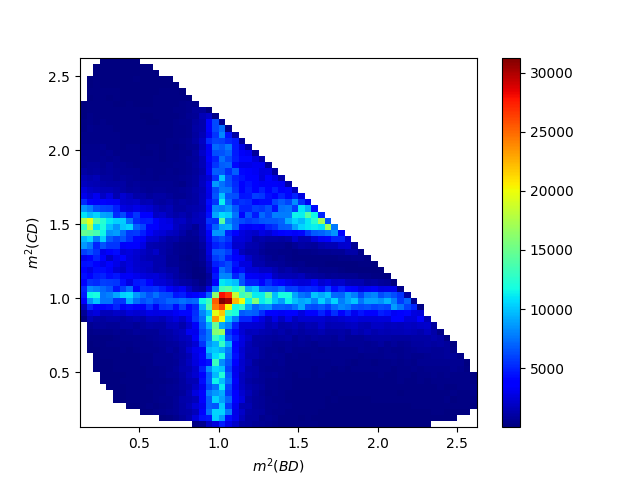
Now by using matplotlib we can get the Dalitz plot as
 91 import matplotlib.pyplot as plt
 92
 93 plt.clf()
 94 plt.hist2d(
 95     m_bd.numpy() ** 2,
 96     m_cd.numpy() ** 2,
 97     weights=amp_s2.numpy(),
 98     bins=60,
 99     cmin=1,
100     cmap="jet",
101 )
102 plt.colorbar()
103 plt.xlabel("$m^2(BD)$")
104 plt.ylabel("$m^2(CD)$")
105 plt.show()
Total running time of the script: (0 minutes 2.519 seconds)