dispersion_integral
The dispersion relation is come from the theory for functions of complex variables. When a function \(f(z)\) is analytic in the real axis and vanish when \(z \rightarrow \infty\), The function has the property that the integration over the edge of the upper half plane is zero,
(Source code, png, hires.png, pdf)


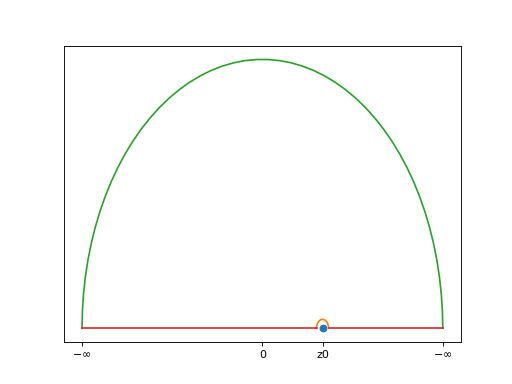
The integration suround the pole \(z_0\) contibute a residue term.
The physical amplitude have the same property after some subtraction of infinity.
Sometimes, additional substrction will be used to make sure that the intergration is finity.
More detials can be found in Dispersion Relation Integrals.
- class DispersionIntegralFunction(fun, s_range, s_th, N=1001, method='tf')[source]
Bases:
LinearInterpFunctionclass for interpolation of dispersion integral.
- class DispersionIntegralParticle(*args, mass_range=(0, 5), mass_list=[[0.493677, 0.493677]], l_list=None, int_N=1001, int_method='tf', dyn_int=False, s0=0.0, **kwargs)[source]
Bases:
ParticleDispersion Integral model. In the model a linear interpolation is used to avoid integration every times in fitting. No paramters are allow in the integration.
\[f(s) = \frac{1}{m_0^2 - s - \sum_{i} g_i^2 [Re\Pi_i(s) -Re\Pi_i(m_0^2) + i Im \Pi_i(s)] }\]where \(Im \Pi_i(s)=\rho_i(s)n_i^2(s)\), \(n_i(s)={q}^{l} {B_l'}(q,1/d, d)\).
The real parts of \(\Pi(s)\) is defined using the dispersion intergral
\[Re \Pi_i(s) = \frac{\color{red}(s-s_{0,i})}{\pi} P \int_{s_{th,i}}^{\infty} \frac{Im \Pi_i(s')}{(s' - s){\color{red} (s'-s_{0,i})}} \mathrm{d} s'\]By default, \(s_{0,i}=0\), it can be change to other value though option
s0: value.value=sthfor \(s_{th,i}\).Note
Small
int_Nwill have bad precision.The shape of \(\Pi(s)\) and comparing to Chew-Mandelstam function \(\Sigma(s)\)
(
Source code,png,hires.png,pdf)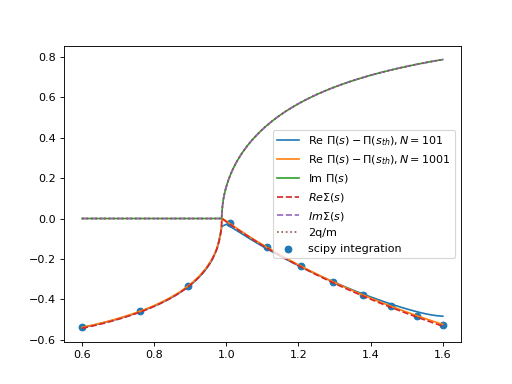
The Argand plot
(
Source code,png,hires.png,pdf)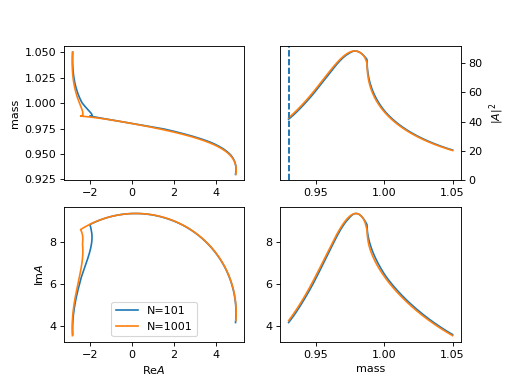
- model_name = 'DI'


- class DispersionIntegralParticleA0(*args, mass_range=(0, 5), mass_list=[[0.493677, 0.493677]], l_list=None, int_N=1001, int_method='tf', dyn_int=False, s0=0.0, **kwargs)[source]
Bases:
DispersionIntegralParticle“DI_a0” model is the model used in PRD78,074023(2008) . In the model a linear interpolation is used to avoid integration every times in fitting. No paramters are allowed in the integration, unless
dyn_int=True.\[f(s) = \frac{1}{m_0^2 - s - \sum_{i} [Re \Pi_i(s) - Re\Pi_i(m_0^2)] - i \sum_{i} \rho'_i(s) }\]where \(\rho'_i(s) = g_i^2 \rho_i(s) F_i^2(s)\) is the phase space with barrier factor \(F_i^2(s)=\exp(-\alpha k_i^2)\).
The real parts of \(\Pi(s)\) is defined using the dispersion intergral
\[Re \Pi_i(s) = \frac{1}{\pi} P \int_{s_{th,i}}^{\infty} \frac{\rho'_i(s')}{s' - s} \mathrm{d} s' = \lim_{\epsilon \rightarrow 0} \left[ \int_{s_{th,i}}^{s-\epsilon} \frac{\rho'_i(s')}{s' - s} \mathrm{d} s' +\int_{s+\epsilon}^{\infty} \frac{\rho'_i(s')}{s' - s} \mathrm{d} s'\right]\]The reprodution of the Fig1 in PRD78,074023(2008) .
(
Source code,png,hires.png,pdf)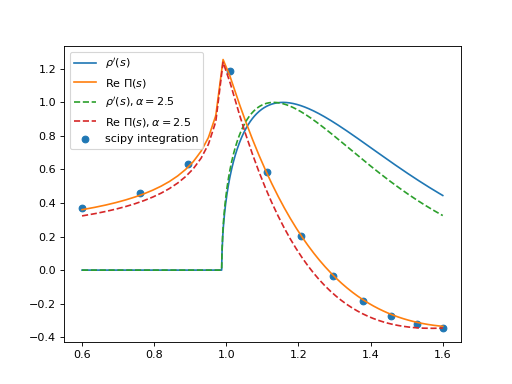
The Argand plot
(
Source code,png,hires.png,pdf)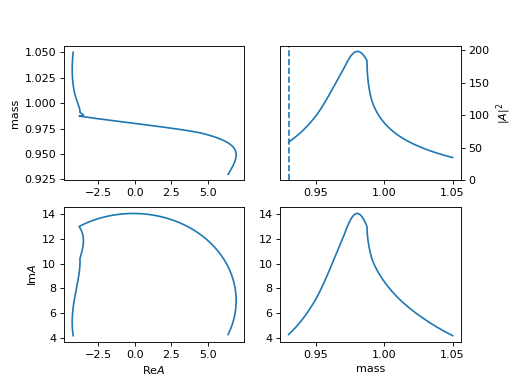
- model_name = 'DI_a0'


- build_integral(fun, s_range, s_th, N=1001, add_tail=True, method='tf')[source]
- \[F(s) = P\int_{s_{th}}^{\infty} \frac{f(s')}{s'-s} \mathrm{d} s' = \int_{s_{th}}^{s- \epsilon} \frac{f(s')}{s'-s} \mathrm{d} s' + \int_{s + \epsilon}^{s_{max} } \frac{f(s')}{s'-s} \mathrm{d} s' + \int_{s_{max}}^{\infty} \frac{f(s')}{s'-s} \mathrm{d} s'\]
It require same \(\epsilon\) for \(s- \epsilon\) and \(s- \epsilon\) to get the Cauchy Principal Value. We used bin center to to keep the same \(\epsilon\) from left and right bound.
- build_integral_scipy(fun, s_range, s_th, N=1001, add_tail=True, _epsilon=1e-06)[source]
- \[F(s) = P\int_{s_{th}}^{\infty} \frac{f(s')}{s'-s} \mathrm{d} s' = \int_{s_{th}}^{s- \epsilon} \frac{f(s')}{s'-s} \mathrm{d} s' + \int_{s + \epsilon}^{s_{max} } \frac{f(s')}{s'-s} \mathrm{d} s' + \int_{s_{max}}^{\infty} \frac{f(s')}{s'-s} \mathrm{d} s'\]
It require same \(\epsilon\) for \(s- \epsilon\) and \(s- \epsilon\) to get the Cauchy Principal Value. We used bin center to to keep the same \(\epsilon\) from left and right bound.
- build_integral_tail(fun, x_center, tail, s_th, N=1001, _epsilon=1e-09)[source]
Integration of the tail parts using tan transfrom.
\[\int_{s_{max}}^{\infty} \frac{f(s')}{s'-s} \mathrm{d} s' = \int_{\arctan s_{max}}^{\frac{\pi}{2}} \frac{f(\tan x)}{\tan x-s} \frac{\mathrm{d} \tan x}{\mathrm{d} x} \mathrm{d} x\]
- build_integral_tf(fun, s_range, s_th, N=1001, add_tail=True)[source]
- \[I(s) = P\int_{s_{th}}^{\infty} \frac{f(s')}{s'-s} \mathrm{d} s' = \int_{s_{th}}^{s- \epsilon} \frac{f(s')}{s'-s} \mathrm{d} s' + \int_{s + \epsilon}^{s_{max} } \frac{f(s')}{s'-s} \mathrm{d} s' + \int_{s_{max}}^{\infty} \frac{f(s')}{s'-s} \mathrm{d} s'\]
It require same \(\epsilon\) for \(s- \epsilon\) and \(s- \epsilon\) to get the Cauchy Principal Value. We used bin center to to keep the same \(\epsilon\) from left and right bound.